Product
The whole lease, in one ledger.
From identification to impairment, from one currency to three, from lessee to lessor. Each workstream is an explicit model with its own evidence, review and support boundary.
01Lessee accounting
Every lease measured from approved facts
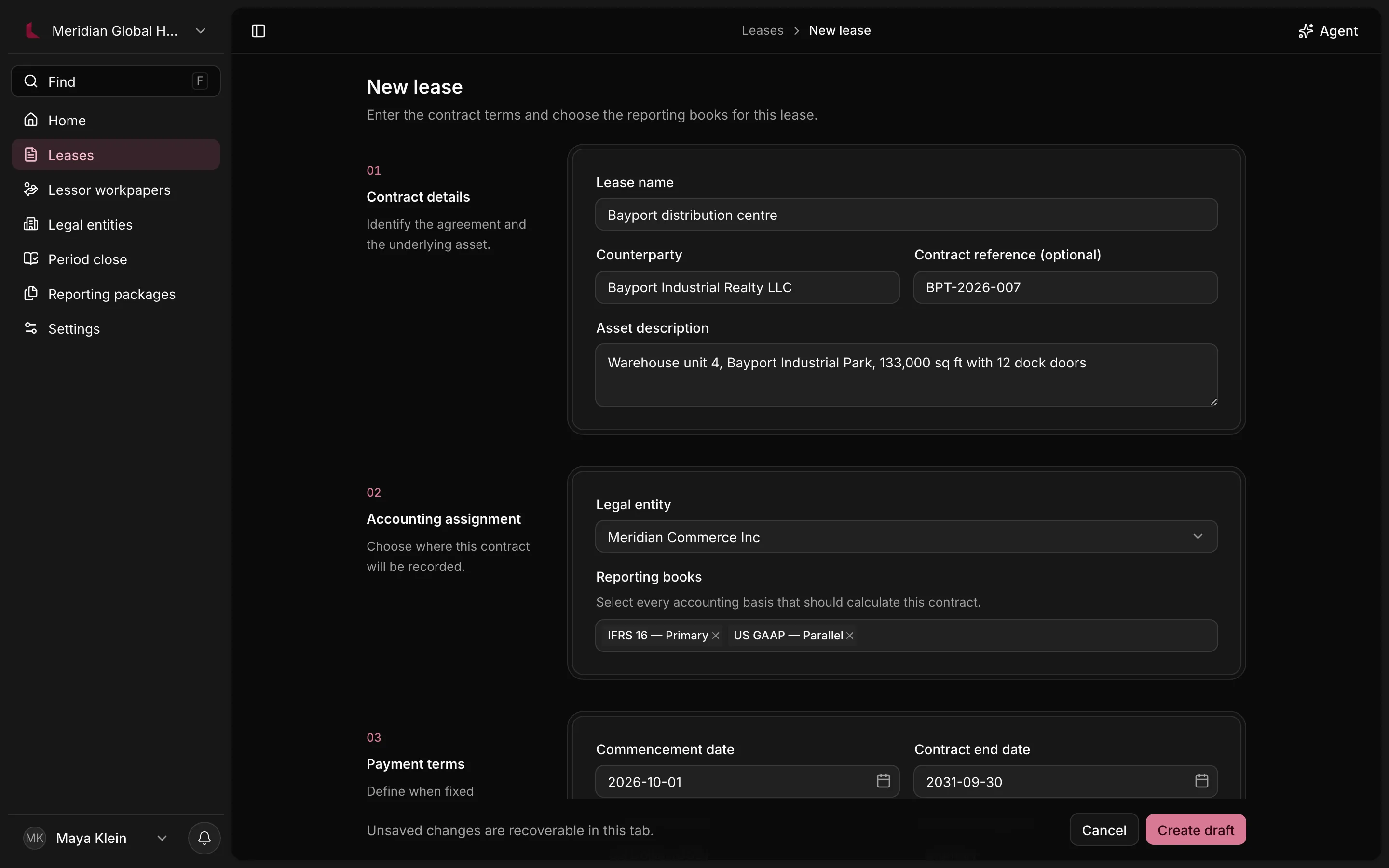
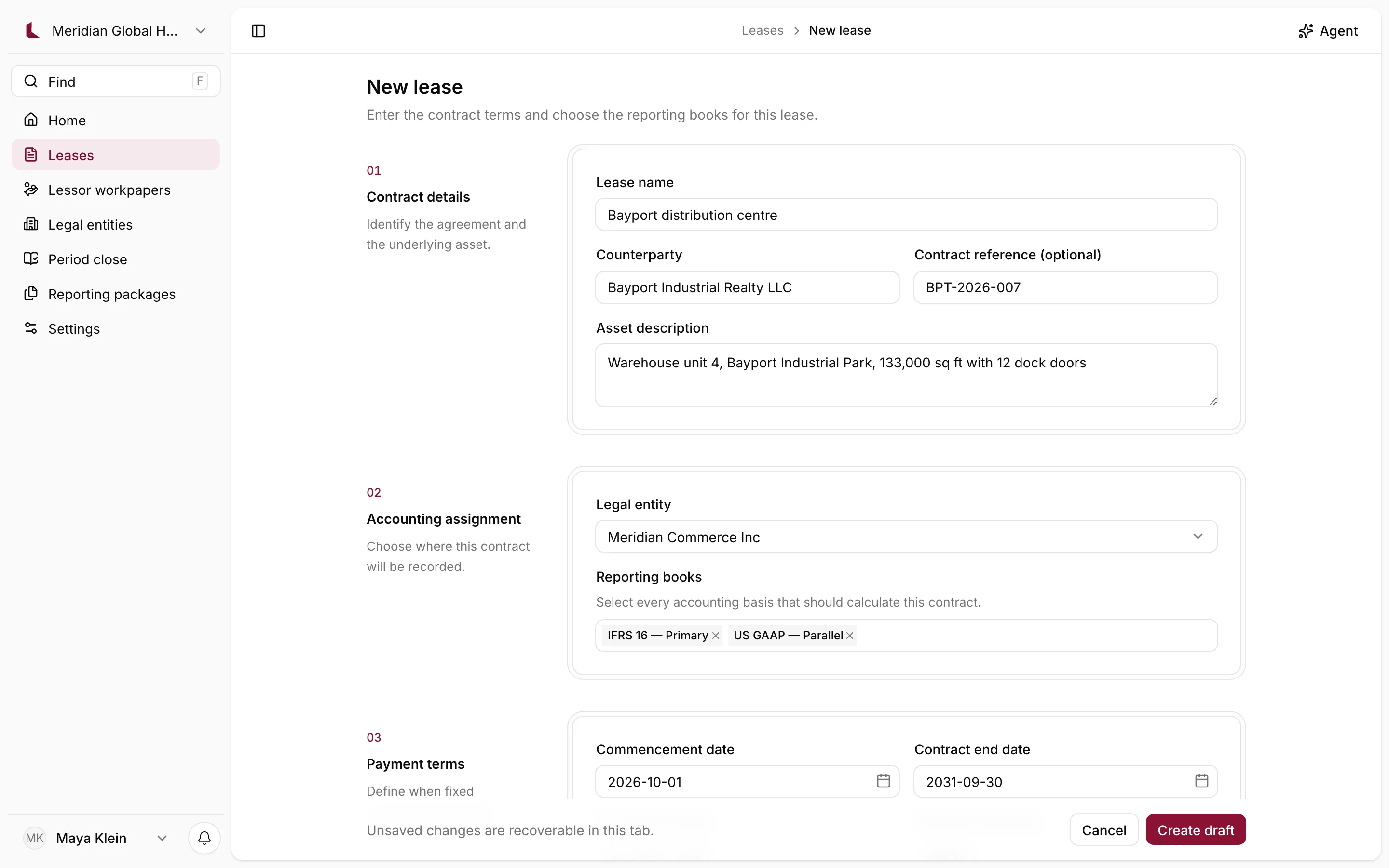
Capture contract facts once and measure them under each reporting book. Payment rules compile into dated cash flows with month-end and leap-year safe calendars.
- IFRS 16 cost model and ASC 842 finance and operating paths
- Fixed, stepped and rent-free payment segments
- Monthly, quarterly and annual frequencies, in advance or arrears
- Prepaid payments, incentives and initial direct costs in the ROU asset
- Short-term and low-value elections with explicit exempt treatment
- Useful-life-aware depreciation instead of a silent payment-term default
02Identification & components
Identification before measurement
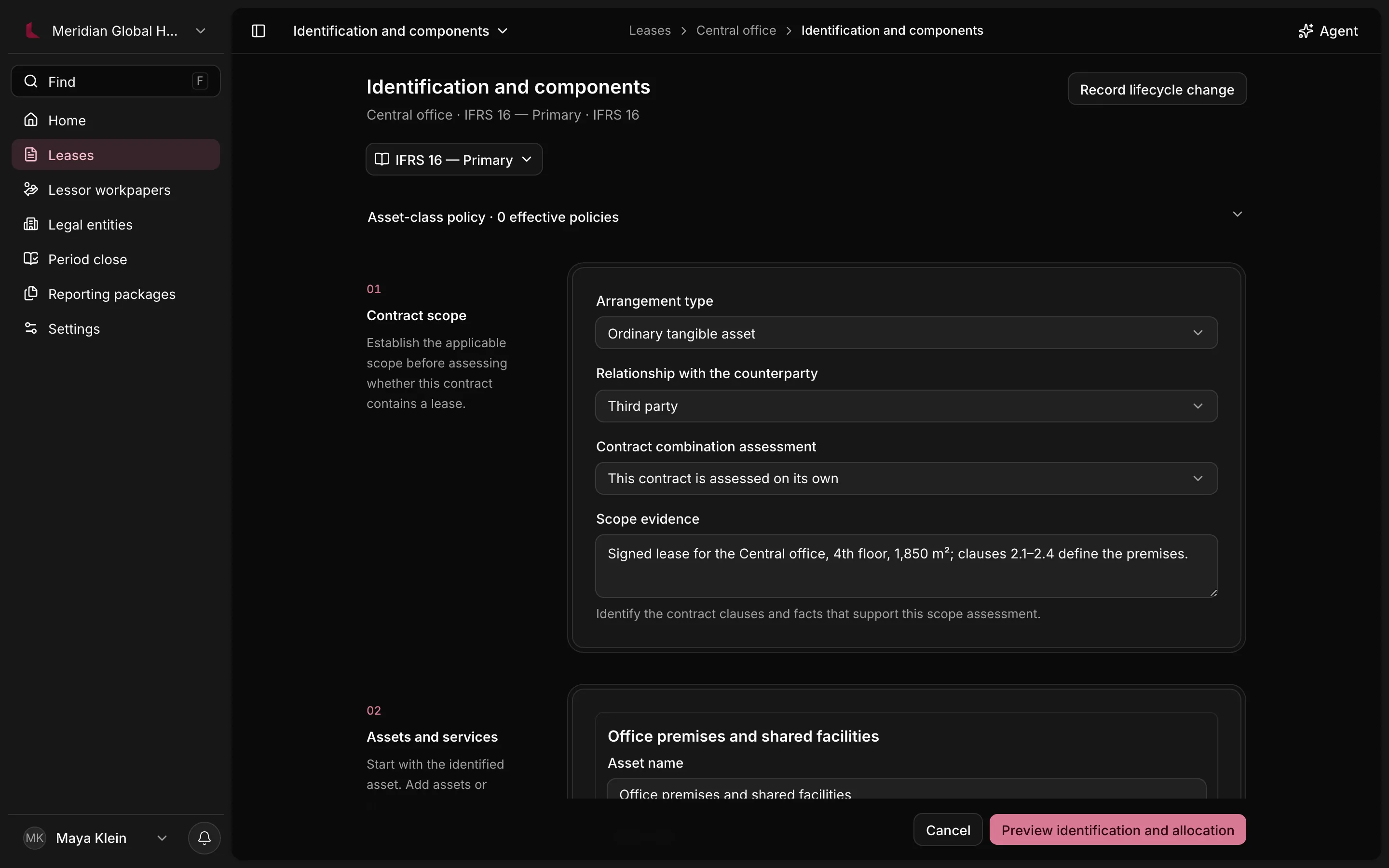
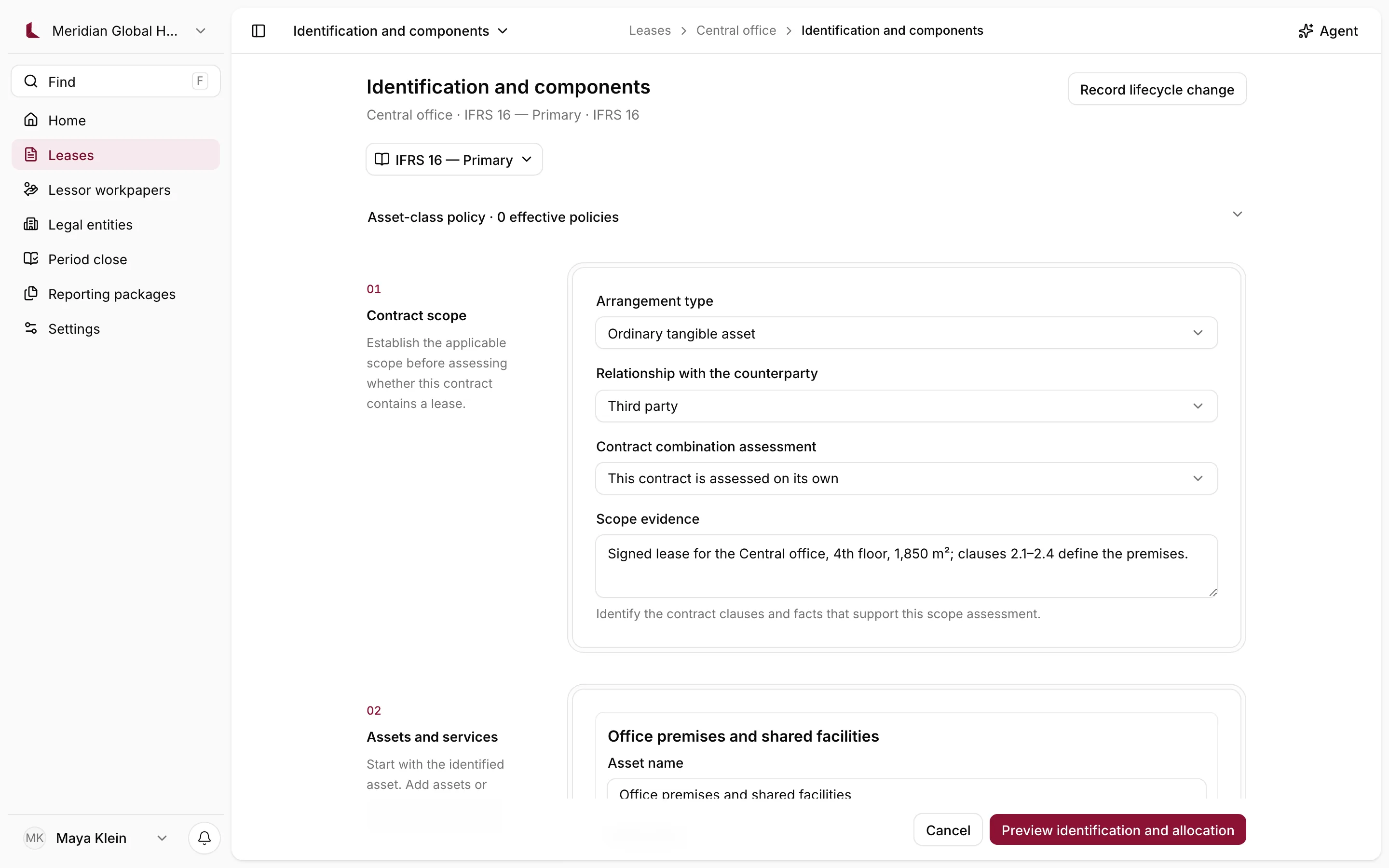
Decide whether a contract contains a lease before you measure it, and which payments belong to which component.
- Scope, identified asset, substitution and right-to-direct assessments
- Lease, service and non-component charges kept distinct
- Relative stand-alone price allocation with rounding reconciliation
- Non-separation elections scoped by asset class, with a preview
- Versioned conclusions tied to the contract and book they affect
03Index & variable payments
CPI resets and variable rent, by the book
Index-linked, rate-linked and genuinely variable payments are recorded by substance, so cash owed, liability-measured amounts and variable expense never blur together.
- Fixed, in-substance fixed, index/rate-linked and usage clauses
- Commencement observations by series, vintage and cut-off
- CPI resets remeasure under IFRS 16 and flow to expense under ASC 842 until a qualifying event
- Floating-rate resets with revised-rate decisions
- Actual variable costs with evidence, allocation and settlement status
Liability after a CPI reset
04Options, guarantees & rates
Judgements with provenance
Options, purchase prices, termination penalties, residual value guarantees and discount rates are explicit, evidenced decisions rather than booleans and a number.
- Renewal, termination and purchase clauses with notice dates
- Reasonably-certain purchase measurement and separate asset horizons
- IFRS expected-payable and ASC probable-owed guarantee amounts
- Implicit rate or evidenced IBR, with eligible ASC risk-free class elections
- Dated quotes with convention, compounding and currency context
Lease term decision · IFRS 16 — Primary
- Commencement2024-08-01
- Termination option notice2026-01-31
- Enforceable term ends2027-07-31
- Renewal notice · reasonably certain2027-04-30
- Lease term used for measurement2030-07-31
Rate: evidenced IBR 6.50% · nominal annual · monthly compounding · USD · 6-year quote dated 2024-07-26
05Modifications & impairment
Lifecycle events from the right opening balance
Account for change from the correct effective-date balances. Each event is assessed by type, previewed across books and journalled as a delta.
- Modifications, separate-lease assessments and reallocation
- Remeasurement with retained or revised rates and ROU adjustment
- Partial and full terminations, including negotiated term reductions
- IAS 36 and ASC 360 impairment with book-specific treatment
- IFRS impairment reversals capped at the permitted ceiling
- Same-day ordering and closed-period correction flows
Partial termination · effective 2026-08-01
| Liability before event | 184,226.41 | |
| Surrendered proportion (40%) | (73,690.56) | derecognized |
| ROU derecognized | (70,112.30) | |
| Gain on partial termination | 3,578.26 | P&L |
| Remeasured retained liability | 108,904.12 | revised rate |
Illustrative figures. Journals post only the delta from event-date balances.
06Foreign currency
Foreign currency without shortcuts
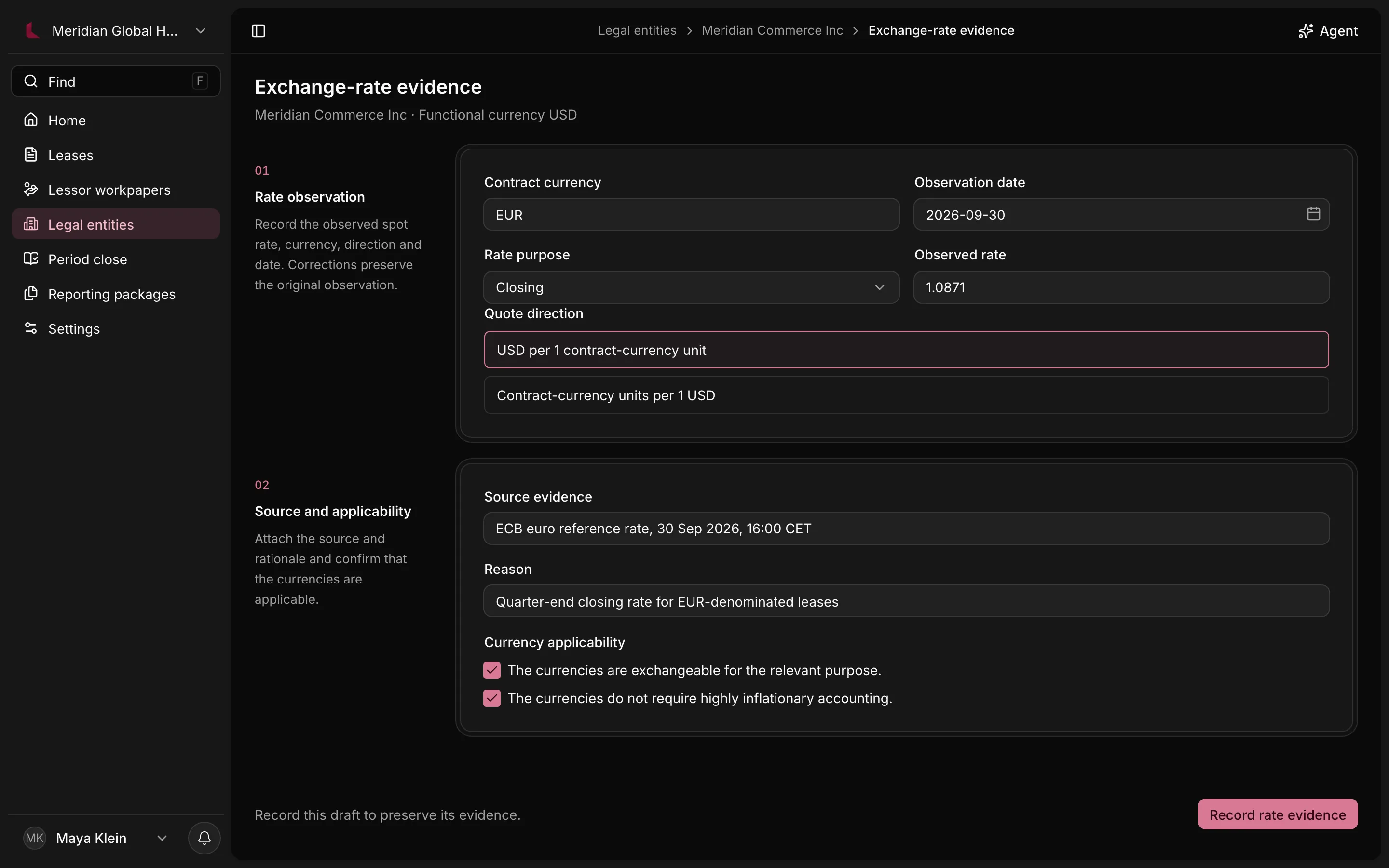
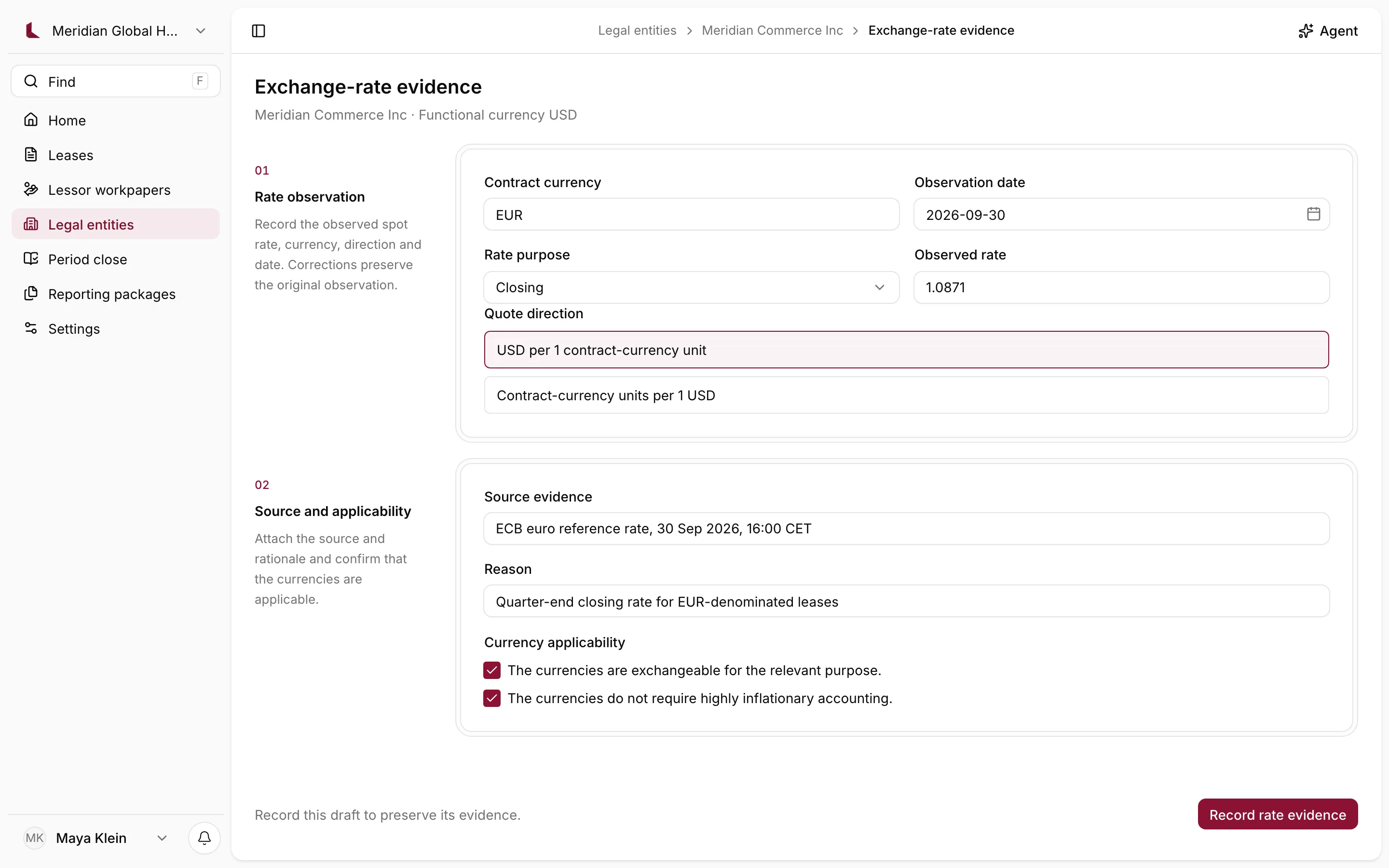
Contract, functional and presentation currencies each play their own role. Rates are immutable evidence with a source, direction and observation time.
- Historical-basis ROU layers and monetary liability remeasurement
- Settlement exchange differences from actual cash
- Separate presentation translation with its own movement
- Decimal conversion with currency-correct rounding, including JPY and KWD
- Fail-closed results for non-exchangeable or hyperinflationary cases
07Reporting & transition
Disclosure packages that reproduce
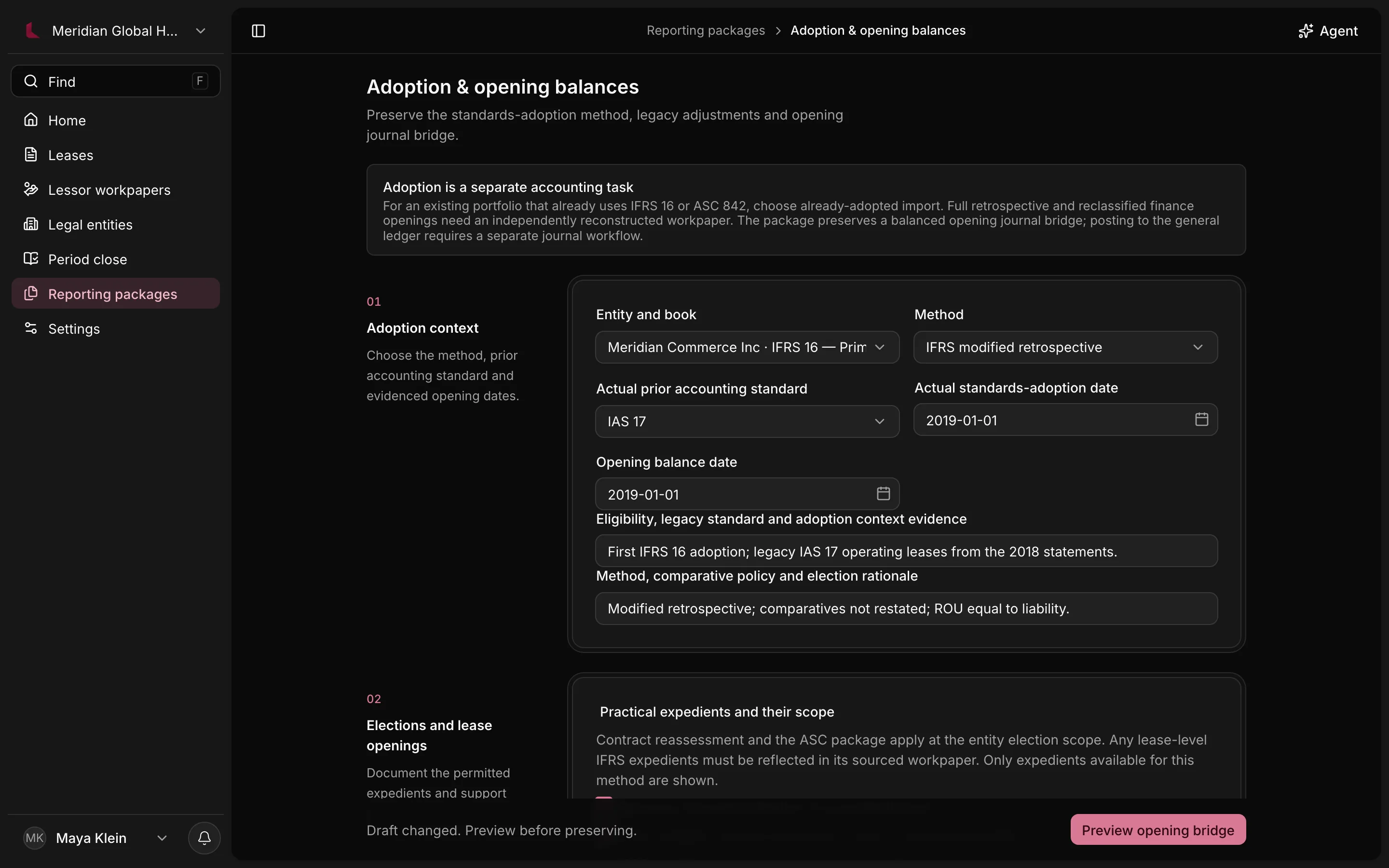
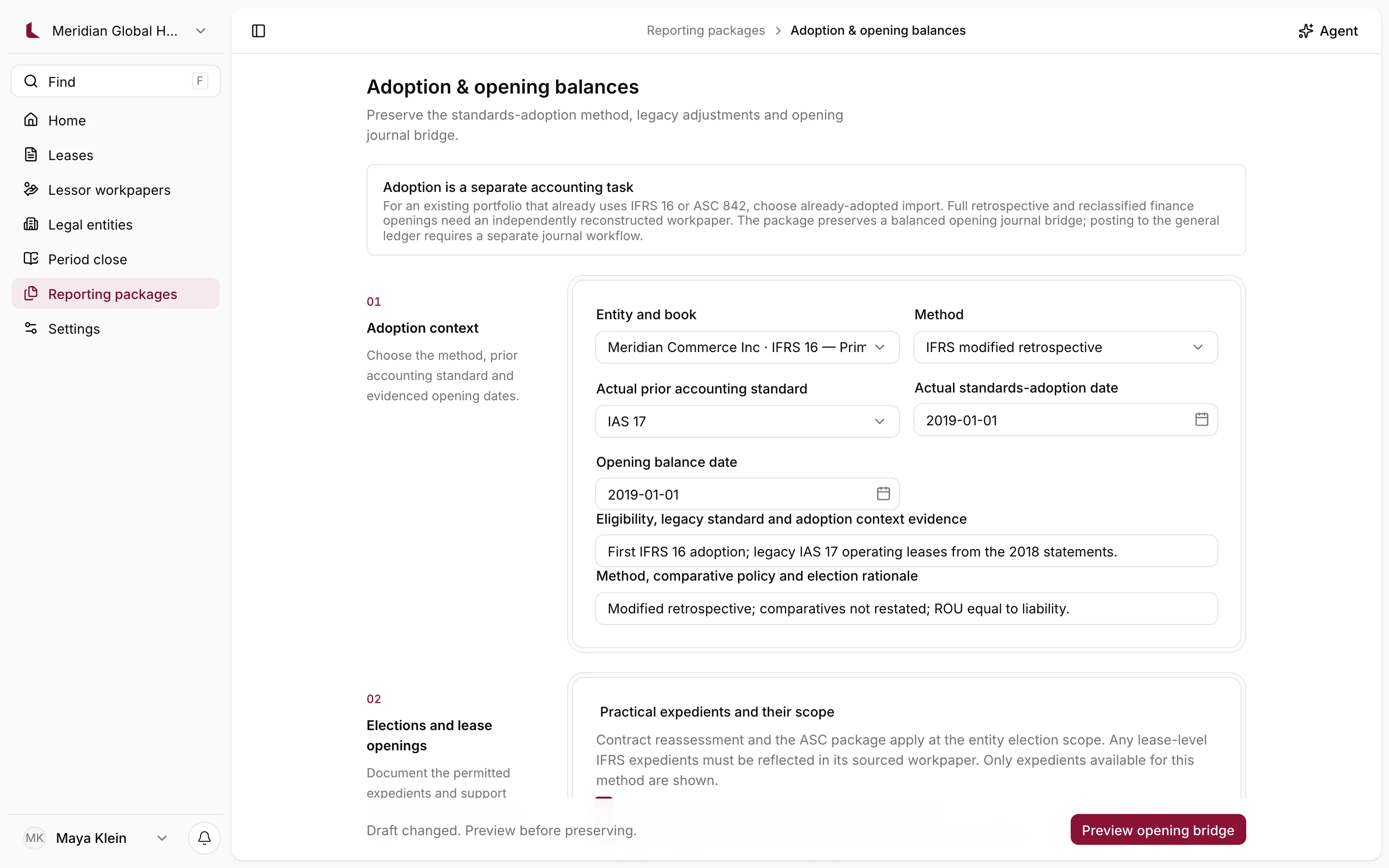
Build period-end working papers and disclosures where every figure traces to approved facts and journals, then freeze them for review.
- Standard-specific disclosure checklists and comparatives
- Liability and ROU roll-forwards with cash and non-cash movements
- Maturity analyses that reconcile undiscounted cash to the liability
- Current and non-current split and ASC weighted-average term and rate
- Adoption workflows with opening-balance bridges
- Frozen packages with input and output hashes
08Lessor & subleases
Both sides of the lease
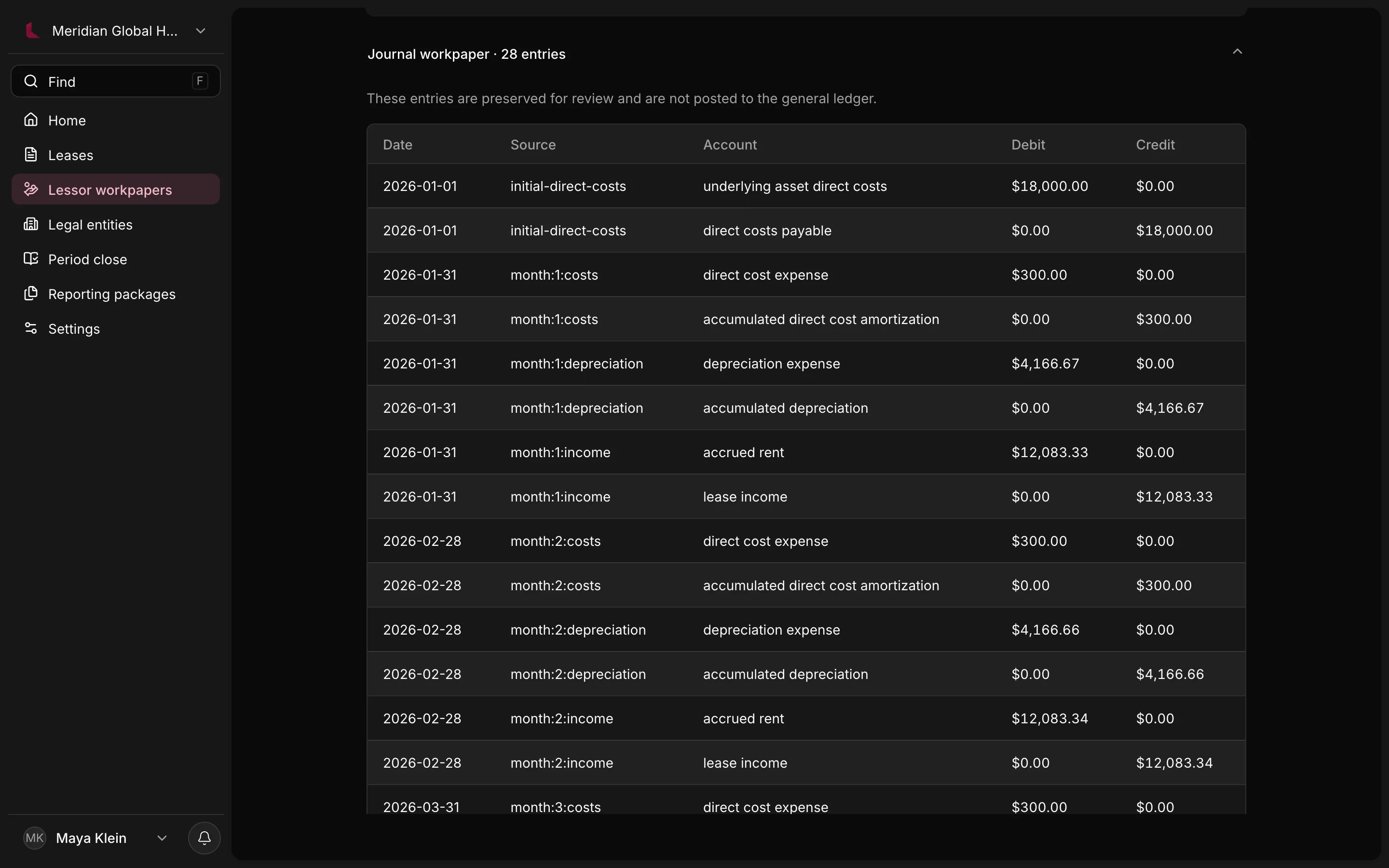
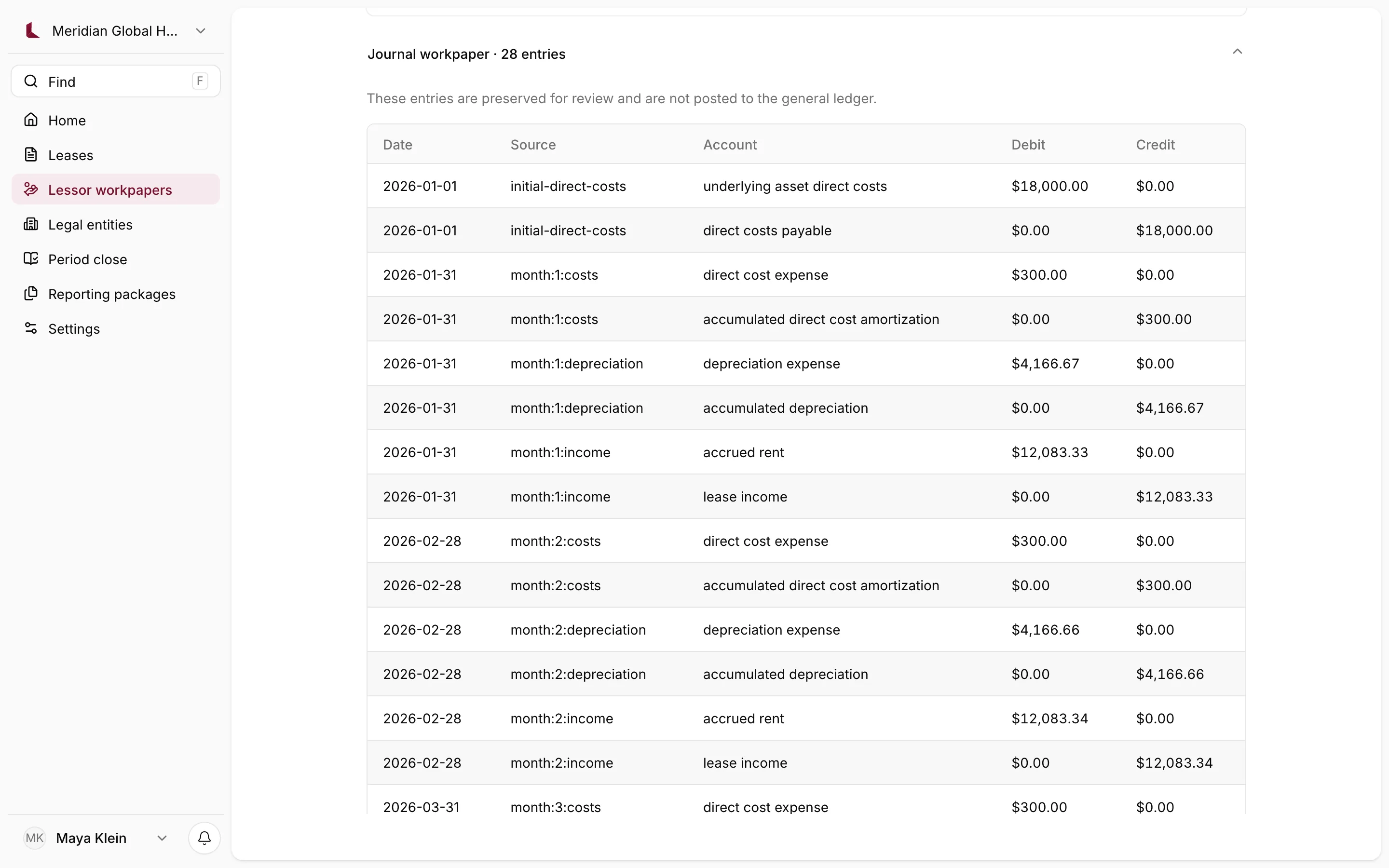
Role accounting supports owned-asset lessors, linked head leases and subleases, and both sides of a sale and leaseback, each through preview, preserve, review and explicit journal acceptance.
- Operating and finance lessor workpapers
- Sublease classification by reference to the head lease
- Seller-lessee and buyer-lessor sale-and-leaseback roles
- Scoped immutable ledgers with mapped accounts
- Reporting reconciles linked figures without double posting
09Controls
The same controls wrap every workstream.
A remeasurement or a sublease is reviewed, closed and exported exactly like a new lease.
Review controls. Calculation and journal reviews with designated approvers and optional self-approval prohibition.
Period close. Close and reopen by reporting book and period, serialized against accounting writes.
Reversals. Immutable reversals with provenance; posted debit and credit lines are never edited.
Audit history. Audit events for membership, policy, approvals, calculations, close and exports.
Durable exports. Worker-generated CSV exports, hashed and stored durably with actor and scope.
Change reports. Change reports compare calculation versions so reviewers see exactly what moved.
What Leasecount won't pretend to do. Inputs outside a documented boundary are rejected with a reason, never built on a silent guess.
- Tax accounting
- Direct posting to a general ledger (exports are CSV)
- SSO, SCIM and custom enterprise roles (planned)
- AI-extracted accounting judgements without human approval
- Inputs outside a documented support boundary, which are rejected rather than approximated
Start with one lease.
Bring in a contract, assign your books and see the schedule your auditor will ask for.